
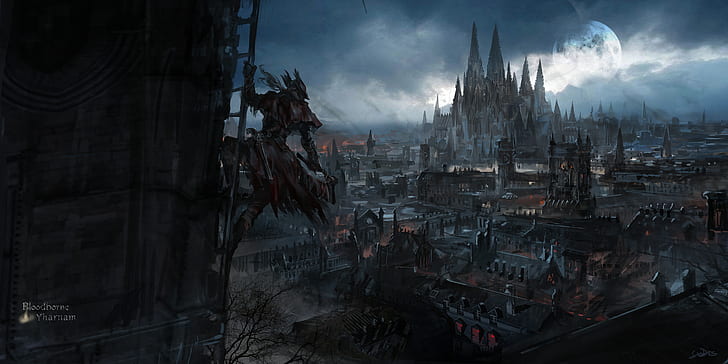
When discussing narrative opportunities provided by the videogame format, perhaps the clearest example is the use of environmental storytelling. This is where the level design is used for exposition, instead of dialogue and character action telling the story. Many games do this mostly for the sake of worldbuilding, and still tell their stories through character action. Bioshock, for example, uses environmental storytelling to explain the backstory of each level’s boss, and give information about the setting, but it still features plenty of dialogue and action that drives the story.
Of course, this is not unique to the medium of videogames: Any artistic medium that can depict a setting is capable of environmental storytelling. Due to the player’s ability to control a protagonist, however, and therefore to explore and fixate upon elements of the world at their own pace, it is uniquely positioned to greater emphasise worldbuilding and narrative through setting. Games made by FromSoftware, such as Dark Souls and Bloodborne, are well known for their cryptic narratives, as little information is directly given to the player. Instead, information is given to the player as a reward for exploration, incentivising focus and engagement with the world. Hiding key plot details in Bloodborne, such as the secret boss “Ebrietas, Daughter of the Cosmos” within established areas, such as the Upper Cathedral Ward, reveals the religious organisations connections to the creature, and explaining where they are obtaining the alien blood that is corrupting the city, or at least one source of it.
An interesting consistency between games that emphasise environmental storytelling is the apocalypse, societal collapse, or some form of abandoned space. This makes sense, as it is intriguing to present a player with such a setting without directly clarifying why the location is as it is, creating a mystery for the player to unravel. Such settings also typically lack many (friendly) NPCs, so it is harder to have a character give direct exposition without it feeling forced.
The ability to emphasise environmental storytelling in videogames is certainly a strength of the medium, as the player’s involvement in exploration will likely keep them engaged in a way that they may not be if simply watching a film or reading a book. A two hour film where a silent protagonist explores a post apocalyptic city with no dialogue would not reach a large audience, but plenty of games give the player exactly that experience for longer periods of time, and it is more engaging.
 Heryland
Leave a comment